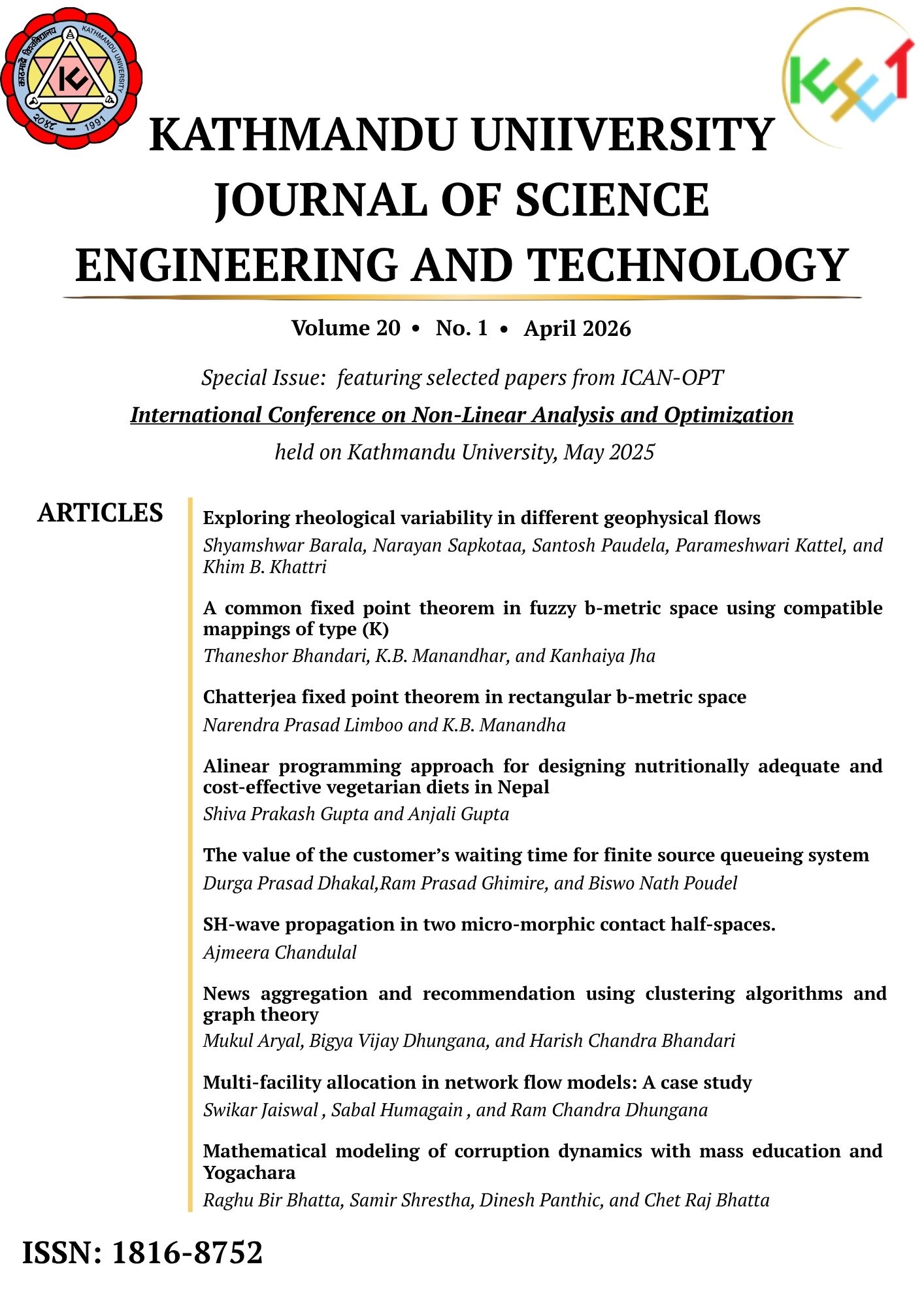
Mathematical modeling of corruption dynamics with mass education and Yogachara
DOI:
https://doi.org/10.70530/kuset.v20i1.722Keywords:
Corruption control, Mass education, Yogāchāra ethics, Corruption-free equilibrium, Corruption-persistent equilibrium, Stability analysisAbstract
Corruption hinders development by undermining public trust, wasting resources, and generating social and economic instability. Despite ongoing efforts, it remains a persistent challenge. This study develops and analyzes a compartmental mathematical model to describe the dynamics of corruption and explore strategies for its control. The model identifies two key states: a corruption-free equilibrium (CFE) and a corruption-persistent equilibrium (CPE). Using the next-generation matrix method, the corruption reproduction number, Re, was derived. Analysis shows that the CFE is stable when Re < 1, whereas the CPE is stable when Re > 1. Sensitivity analysis reveals that corruption driven by greed and poverty has the strongest positive effect on Re, while mass education and Yogācāra (Aparigraha) teachings exert the strongest negative effect. Numerical simulations indicate that the combined implementation of mass education and Yogācāra instruction reduces corruption more rapidly than either intervention alone. Overall, the findings suggest that integrating mass education with ethical instruction provides an effective and sustainable strategy for controlling corruption.
Published
How to Cite
Issue
Section

This work is licensed under a Creative Commons Attribution-ShareAlike 4.0 International License.
This work is licensed under CC BY-SA 4.0