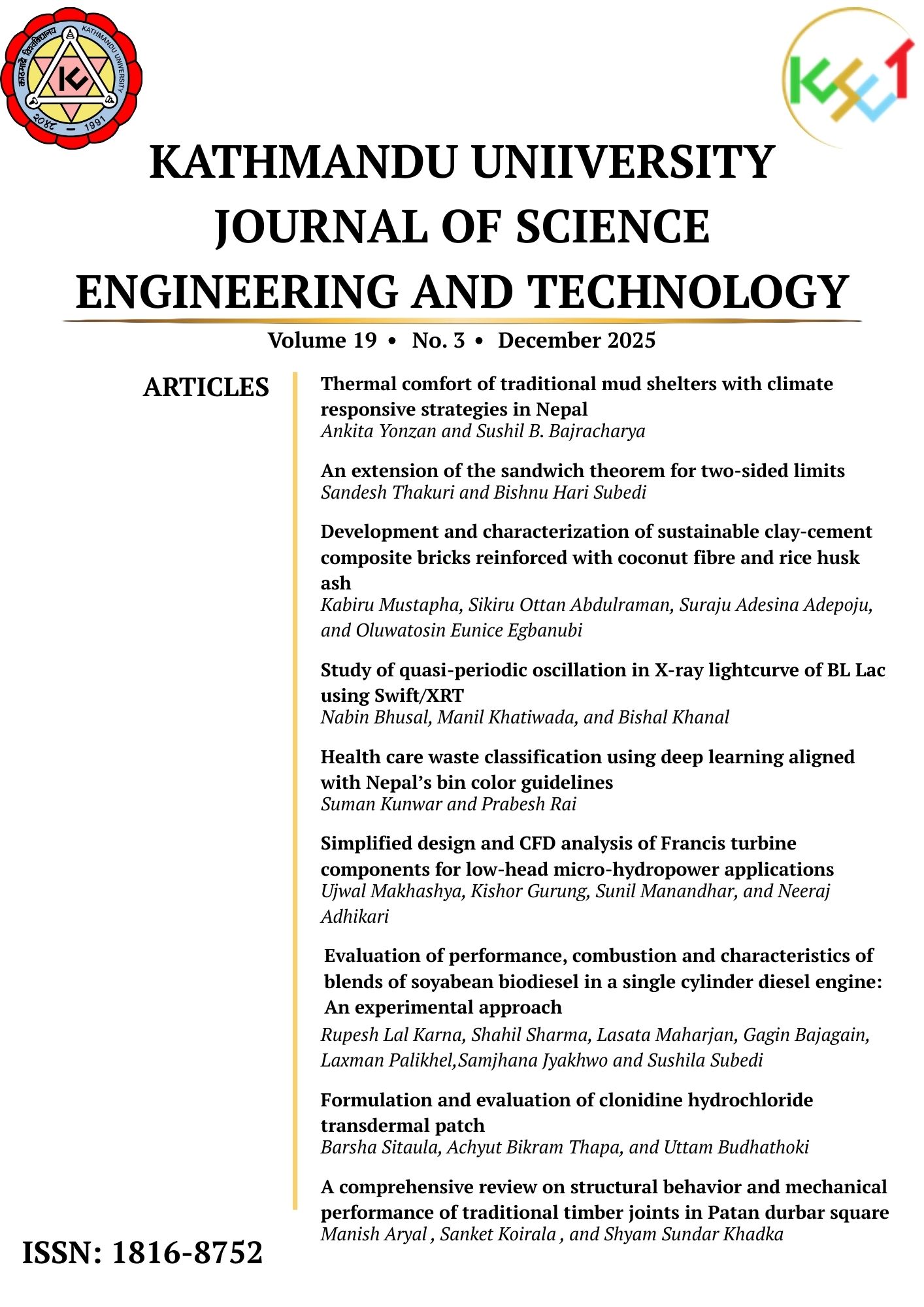
Health care waste classification using deep learning aligned with Nepal's bin color guidelines
DOI:
https://doi.org/10.70530/kuset.v19i3.687Keywords:
Health care waste, Deep learning, Waste classification, Computer vision, Nepal health care waste standardsAbstract
The increasing number of Health Care facilities in Nepal has added up the challenges on managing health care waste (HCW). Improper segregation and disposal of HCWleads to contamination, spreading of infectious diseases and risk for waste handlers. This study benchmarks the state of the art waste classification models: ResNeXt-50, EfficientNet-B0, MobileNetV3-S, YOLOv8-n and YOLOv5-s using stratified 5-fold cross-validation technique on combined HCW data. YOLOv5-s achieved the highest accuracy (95.06%) but fell short with the YOLOv8-n model in inference speed with few milliseconds. The EfficientNet-B0 showed promising results of 93.22% accuracy but took the highest inference time. Following a repetitive ANOVA test to confirm the statistical significance, the best performing model (YOLOv5-s) was deployed to the web with bin color mapped using Nepal’s HCW management standards. Further work is suggested to address data limitation and ensure localized context.
Published
How to Cite
Issue
Section

This work is licensed under a Creative Commons Attribution-ShareAlike 4.0 International License.
This work is licensed under CC BY-SA 4.0